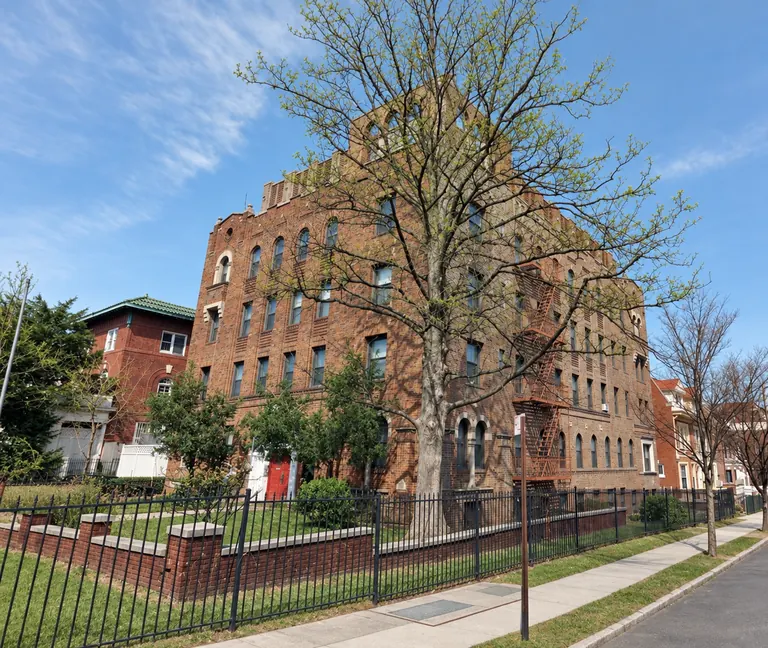
Crown Heights is in the middle of its most significant planning shift in decades. Along its northern edge, the city has rezoned the Atlantic Avenue corridor for housing, and public agencies are now moving sites toward construction. Farther south, smaller projects and street upgrades are reshaping individual blocks. For owners of brownstones, townhouses and small multifamily buildings, these changes are worth understanding before deciding when and how to sell.
The Atlantic Avenue Mixed-Use Plan, Explained
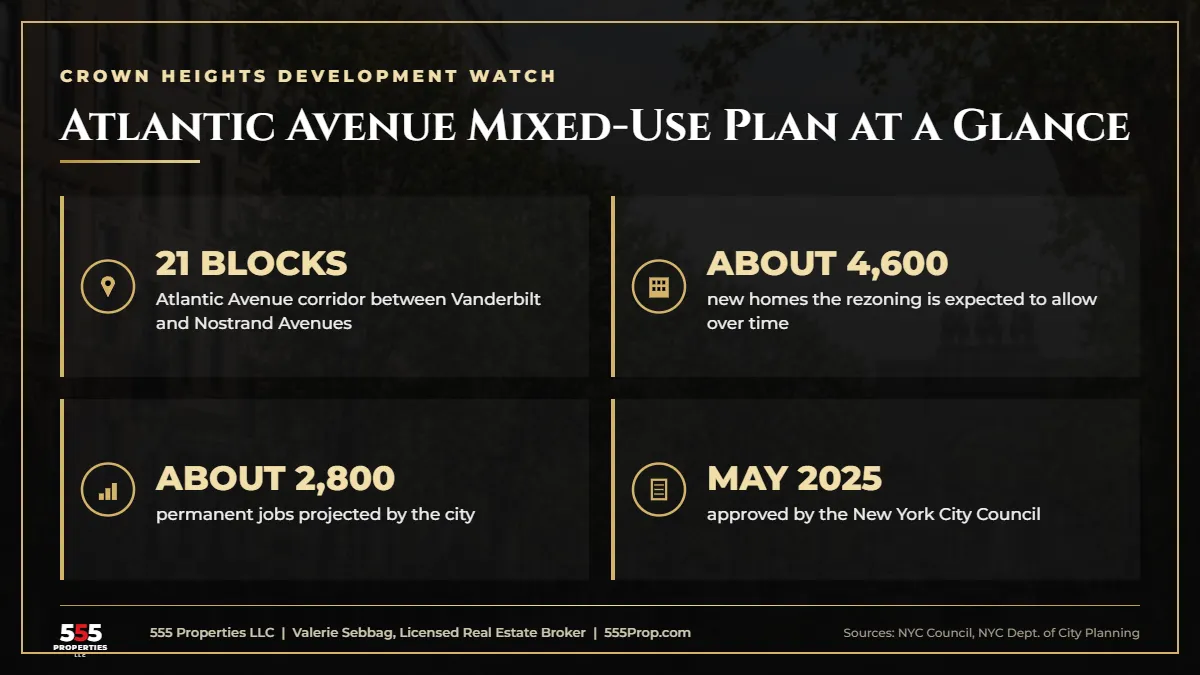
In May 2025 the New York City Council approved the Atlantic Avenue Mixed-Use Plan, known locally as AAMUP. It rezones roughly 21 blocks of Atlantic Avenue and the surrounding streets between Vanderbilt Avenue and Nostrand Avenue, touching northern Crown Heights, Prospect Heights and Bedford-Stuyvesant. For decades much of this stretch allowed only light industrial uses such as warehouses, auto shops and storage. The new zoning permits mixed-use buildings that combine apartments with ground-floor commercial, industrial and community space.
City planners expect the plan to make room for about 4,600 new homes over time, a meaningful share of them income-restricted, along with roughly 2,800 permanent jobs. The approval also came with city commitments for infrastructure and public space, including a redesign of Atlantic Avenue itself, a renovation of St. Andrew’s Playground and upgrades to Lowry Triangle near Washington Avenue.
From Zoning Map to Construction Sites
A rezoning only sets the rules. The real change begins when individual sites trade and permits are filed, and 2026 has shown that process is underway. Several development parcels inside the rezoned area changed hands this year, according to public reports, as builders positioned for mid-rise residential projects.
Public land is moving too. In March 2026 the Metropolitan Transportation Authority invited proposals for its lot at 1119 Pacific Street, together with air rights over the adjacent Franklin Avenue Shuttle. The agency described a project of roughly 300 homes, at least 75 of them affordable, with sale proceeds supporting its capital program. Projects on this scale take years to design, finance and build, so the corridor will change gradually rather than overnight.
Closer to the Parkway: Smaller Projects, Visible Change
Not every change is corridor-sized. On Eastern Parkway between Franklin and Classon Avenues, an eight-story, all-electric condominium with five residences reached completion after topping out in 2024. You can read our earlier coverage in New Development Nears Completion at 311 Eastern Parkway. Boutique buildings like this add new-construction options to a neighborhood dominated by prewar housing, which helps buyers compare and gives well-kept historic homes a clear point of contrast.
The city is also investing in the parkway itself. The NYC Department of Transportation has proposed accessibility upgrades at bus stops along Eastern Parkway between Schenectady and Ralph Avenues, working with NYC Parks on materials suited to the landmarked boulevard.
What This Means If You Own a Home Nearby
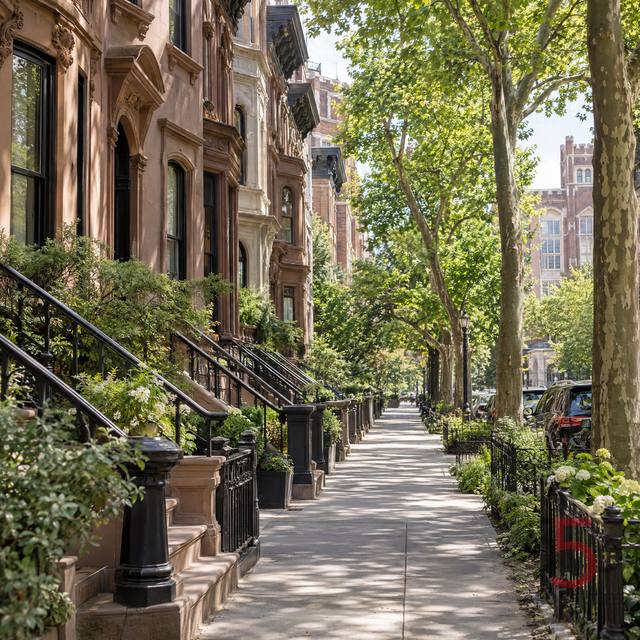
Planning changes can shape how buyers view a neighborhood, but they affect individual properties in different ways. Proximity to new retail and transit improvements can be attractive to some buyers, while others focus on construction activity or on how a new building changes light and views on a block. No one can promise how a specific house will be affected, which is why a block-by-block view matters more than headlines.
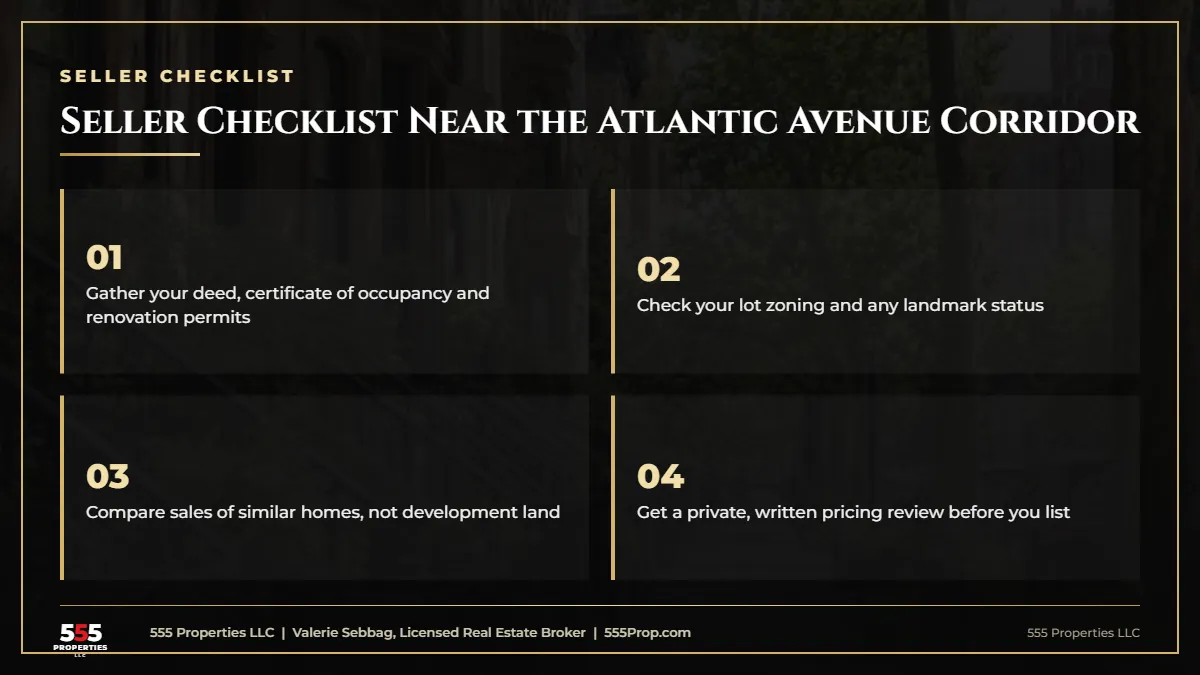
Questions worth answering before you list
- Is your property inside the rezoned area, next to it, or several blocks away? The city’s ZoLa zoning map shows the current district for any lot.
- Is your building in the Crown Heights North Historic District, where exterior changes need Landmarks Preservation Commission review?
- Do your records match the property: certificate of occupancy, permits for past renovations and the legal number of units?
- Which recent sales of comparable homes, not development sites, best reflect your property’s condition and layout?
A Neighborhood Still Defined by Its Blocks
For all the attention on Atlantic Avenue, most of Crown Heights is not changing its basic character. Its rows of brownstones, limestones and early apartment houses, along with landmarks like Eastern Parkway and the institutions near Grand Army Plaza, remain what draws long-term buyers. Our guide Discover Crown Heights: A Blend of Heritage, Culture and Community covers that history, and Crown Heights Real Estate Market: Growth, Change and Results looks at how sellers can position a home today.
If you are weighing a sale, start with the details of your own property. Our Crown Heights brownstone selling guide walks through preparation, and you can request a private valuation from Valerie for a pricing range grounded in comparable sales. You can also learn more about working with a Crown Heights realtor who focuses on sellers.