
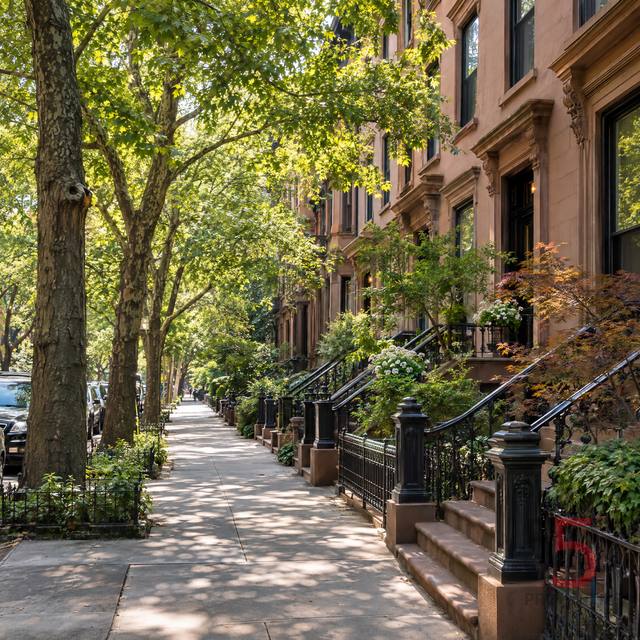
Crown Heights is one of Brooklyn’s most layered neighborhoods. In a few blocks you can pass a nineteenth century free Black settlement, the world’s first children’s museum, a grand Olmsted and Vaux boulevard, and avenues filled with Caribbean bakeries, wine bars and family-run shops. That depth is a large part of why people choose to live here, and why homes here hold lasting appeal.
Roots That Run Deep
Weeksville
In 1838, James Weeks, a free Black man, purchased land in what is now eastern Crown Heights, and the community that grew there became one of the largest free Black settlements in the United States before the Civil War. Today the Weeksville Heritage Center preserves the historic Hunterfly Road Houses and tells that story through exhibitions and programs.
A boulevard built for the city
Eastern Parkway, designed by Frederick Law Olmsted and Calvert Vaux in the 1870s, gave the area its spine. Its tree-lined malls still link Crown Heights to Prospect Park, the Brooklyn Museum and the Brooklyn Botanic Garden at its western end.
Culture in Every Direction
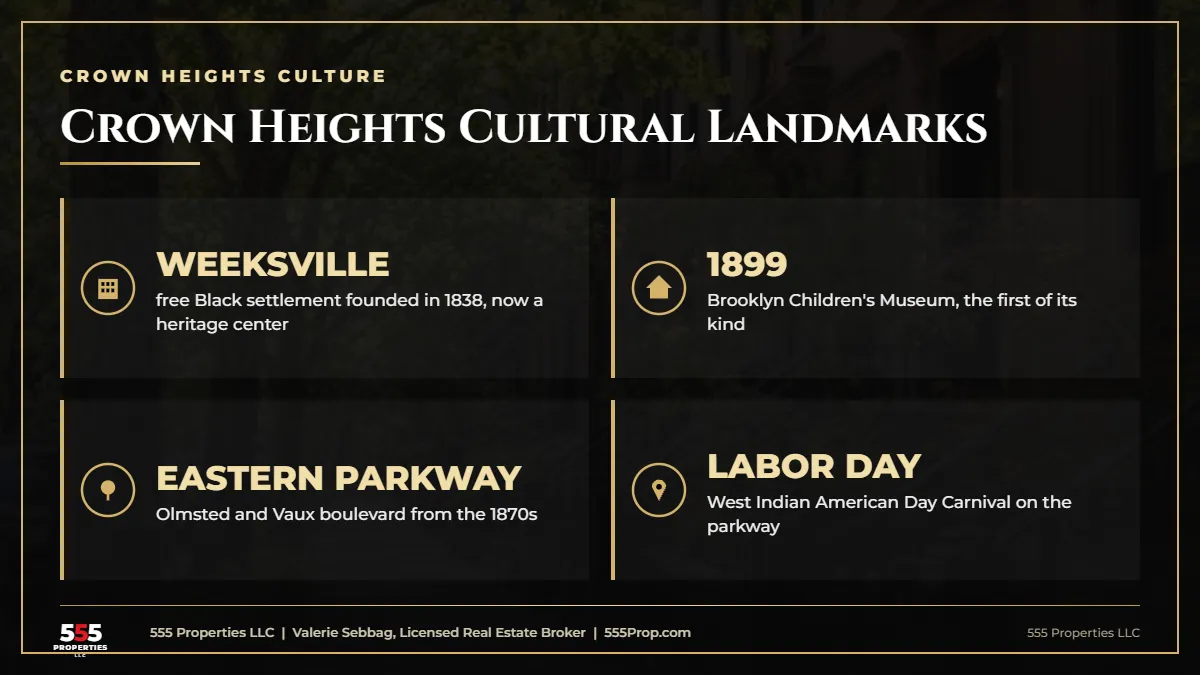
- Brooklyn Children’s Museum. Founded in 1899 and widely recognized as the first museum in the world created for children, it sits in Brower Park.
- The West Indian American Day Carnival. Each Labor Day, Eastern Parkway hosts one of the largest Caribbean celebrations in North America, a reflection of the neighborhood’s deep Caribbean heritage.
- 770 Eastern Parkway. The world headquarters of the Chabad-Lubavitch movement draws visitors from around the world and anchors a large Orthodox Jewish community.
- Medgar Evers College. A senior college of the City University of New York, located in Crown Heights.
Where Daily Life Happens
Franklin Avenue has become one of Brooklyn’s liveliest dining strips, while Nostrand Avenue and Rogers Avenue carry decades of Caribbean restaurants and bakeries. Kingston Avenue serves the Orthodox Jewish community with kosher markets and shops. Smaller corridors along Utica Avenue and Washington Avenue round out a neighborhood where most daily needs are within a short walk.
Getting Around
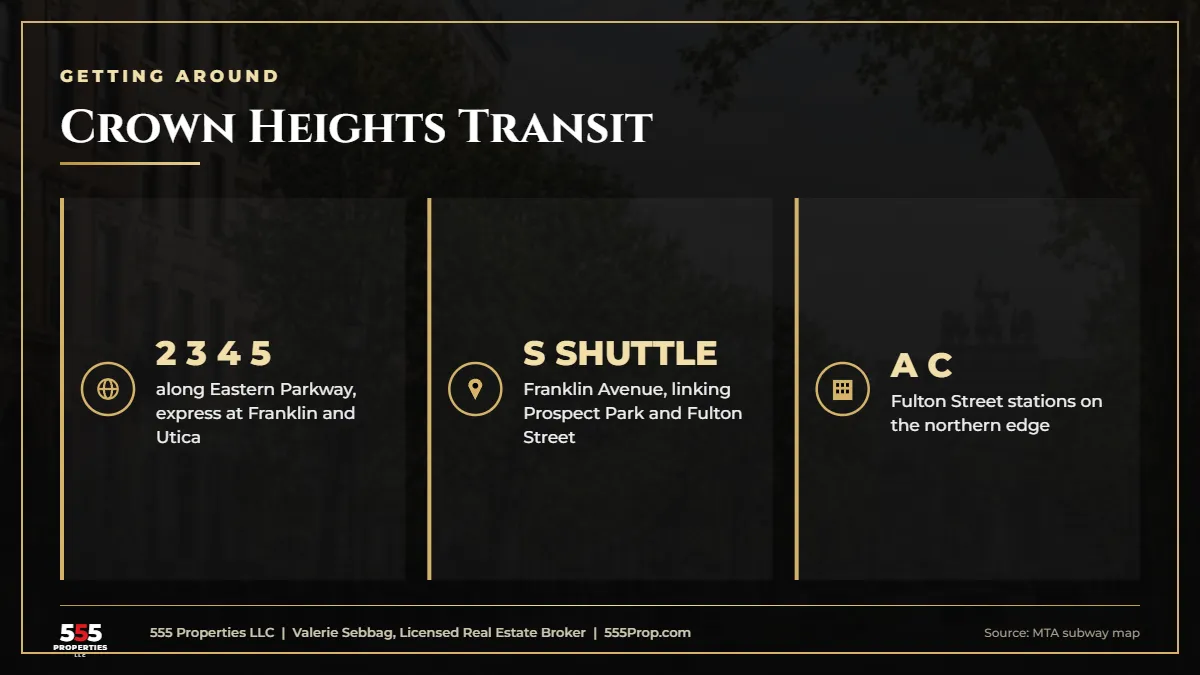
Transit is one of the neighborhood’s strongest assets. Eastern Parkway carries the 2, 3, 4 and 5 lines, with express stops at Franklin Avenue and Utica Avenue. The Franklin Avenue Shuttle connects south to Prospect Park and north to the A and C at Fulton Street. Many blocks are a single subway ride from Downtown Brooklyn and Lower Manhattan.
Why This Matters When You Sell
Buyers rarely choose a house alone. They choose a block, a commute and a way of life. When you list a Crown Heights home, the story of the neighborhood is part of the value, and good marketing tells it accurately: the walk to the subway, the nearby park, the history of the block and the character of the house itself.
To explore further, read From Carroll Street to Lincoln Place, our Crown Heights neighborhood guide and the Remsen Village guide for the area to the southeast. If you are thinking about selling, request a private valuation or learn more about working with a Crown Heights realtor.



Join The Discussion