Across New York City, investors increasingly separate small apartment buildings into two very different categories: those whose units are free-market and those that are mostly rent-stabilized. The rules that govern each have diverged since 2019, and that difference now sits at the center of how buildings are valued. If you own a two to twenty unit building in Brooklyn and are thinking about selling, it is the first thing to understand.
Why the Two Categories Diverged
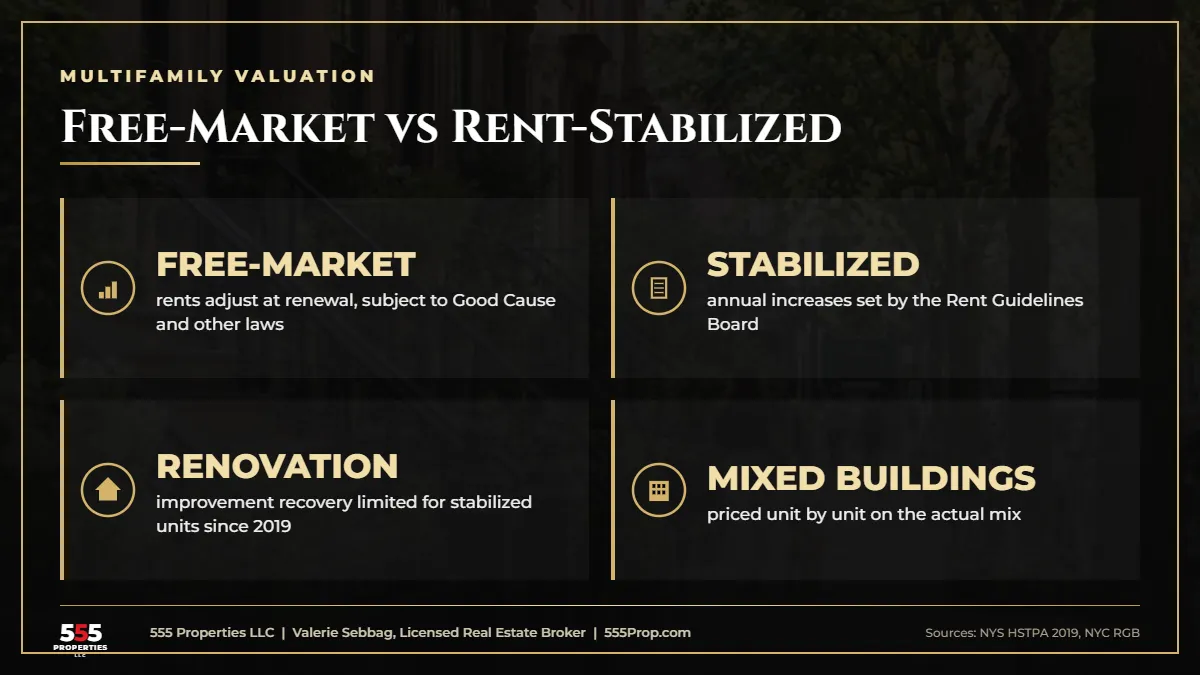
In June 2019, New York State passed the Housing Stability and Tenant Protection Act. Among other changes, it ended vacancy decontrol and high-rent deregulation, removed the vacancy bonus, and limited how much owners can recover through individual apartment improvements and major capital improvements. For rent-stabilized units, annual lease increases are set by the city’s Rent Guidelines Board.
The practical effect is that income from stabilized units grows within set limits, while expenses such as taxes, insurance and repairs do not. Free-market units, by contrast, can adjust to market rents at lease renewal, subject to other laws such as New York City’s 2024 Good Cause Eviction law, which applies to many market-rate apartments, with exemptions that include certain small landlords.
What Buyers Look At
- Rent roll and lease terms. Current rents, lease expiration dates and how each unit is classified.
- Registration history. For stabilized units, rent registrations with the state’s Division of Housing and Community Renewal.
- Operating expenses. Taxes, insurance, utilities, repairs and management, ideally for two or more years.
- Building condition. Roof, boiler, facade, plumbing and electrical, plus open violations with HPD or the Department of Buildings.
- Legal use. A certificate of occupancy that matches the number of units in use.

Mixed Buildings Are Common
Many Brooklyn buildings hold both kinds of units, especially older walk-ups. In those cases, pricing depends on the specific mix and on realistic projections for each unit, not on a blanket assumption. Owner-occupied two to four family homes form another group: buyers often plan to live in one unit and rent the others, which can broaden the buyer pool considerably. Our article on multifamily properties in Brooklyn looks at that segment.
New Construction and 485-x
In 2024, New York replaced the expired 421-a tax incentive with a new program known as 485-x, which ties tax benefits for new rental construction to affordability and, for larger projects, wage requirements. It shapes what developers can build, and so it shapes the value of development sites and of buildings with unused development rights. If your lot has air rights, that can be part of the conversation.

Planning a Multifamily Sale
Before listing, have your documents assembled and reviewed, consider a property condition review, and get tax and legal advice on timing, including whether a 1031 exchange fits your plans. For mixed-use buildings, see our companion article on Brooklyn retail and mixed-use buildings, and for Crown Heights context, Why Investors Are Overlooking Crown Heights.
Valerie Sebbag advises owners of Brooklyn multifamily buildings on pricing and preparation. Request a private valuation or see commercial and investment sales with 555 Properties LLC.